

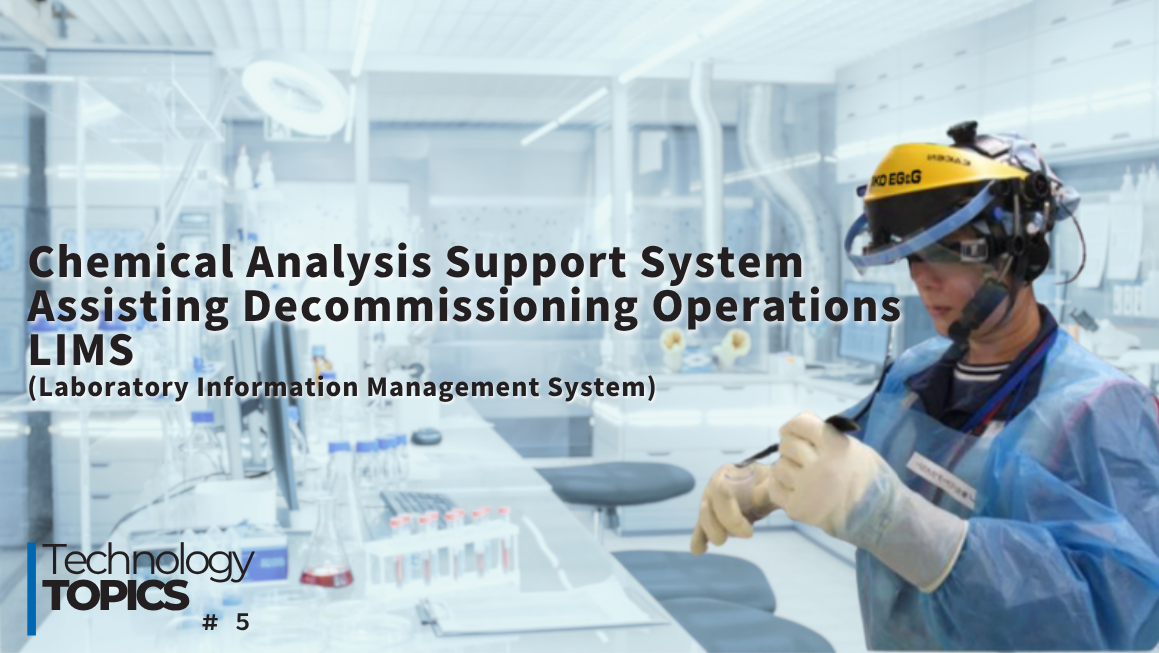
At the Fukushima Daiichi Nuclear Power Station, where decommissioning work continues, radioactivity analyses and water quality analyses of various samples are performed daily. To ensure the massive volume of analysis is carried out accurately and promptly, a chemical analysis support system has been introduced that combines LIMS (Laboratory Information Management System) and smart glasses.
This system was developed by Seiko EG&G Co., Ltd. (hereinafter “SEIKO EG&G”), a Seiko Instruments, Inc. group company. Upon receiving a request and cooperation (provision of necessary functions and ideas) from Tokyo Electric Power Company Holdings, Inc. (hereinafter “TEPCO HD”), a specialized system was built for practical tasks in the chemical analysis industry. This report will explore the background of the development, the technical details, and potential future possibilities.
What is LIMS (Laboratory Information Management System)?
LIMS is a system that integrates and manages operations in laboratories and analytical facilities. It centrally manages everything digitally, including receiving analysis requests, recording/storing data, and generating reports, with the goal of ensuring data reliability and improving operational efficiency. It is used in a wide range of industries, including pharmaceuticals, food, and environmental analysis.
At the Fukushima Daiichi Nuclear Power Station, a LIMS customized from the ground up by SEIKO EG&G has been introduced. In addition to enabling hands-free operation by displaying work procedures step-by-step on the analyst‘s smart glasses, it also features a system that allows on-site analysts and managers to perform double checks in real time.
Massive quantity of chemical analysis at the Fukushima Daiichi Nuclear Power Station
Since the Great East Japan Earthquake, environmental monitoring has been conducted at the Fukushima Daiichi Nuclear Power Station as part of the decommissioning process for the purpose of monitoring the environmental impact of radioactive materials. The scope of analysis covers a wide range, including seawater in the harbor and surrounding waters, groundwater, soil within the site, and drainage channels. Additionally, as part of the maintenance and management of decommissioning facilities, the performance of contaminated water treatment equipment is verified, and ALPS-treated water is also analyzed.
The number of chemical analysis items comes to approximately 80,000 per year, which is about 16 times higher than it was before the earthquake. Measurements are conducted on a 24-hour basis, and all measurement results are published daily on the TEPCO HD website.
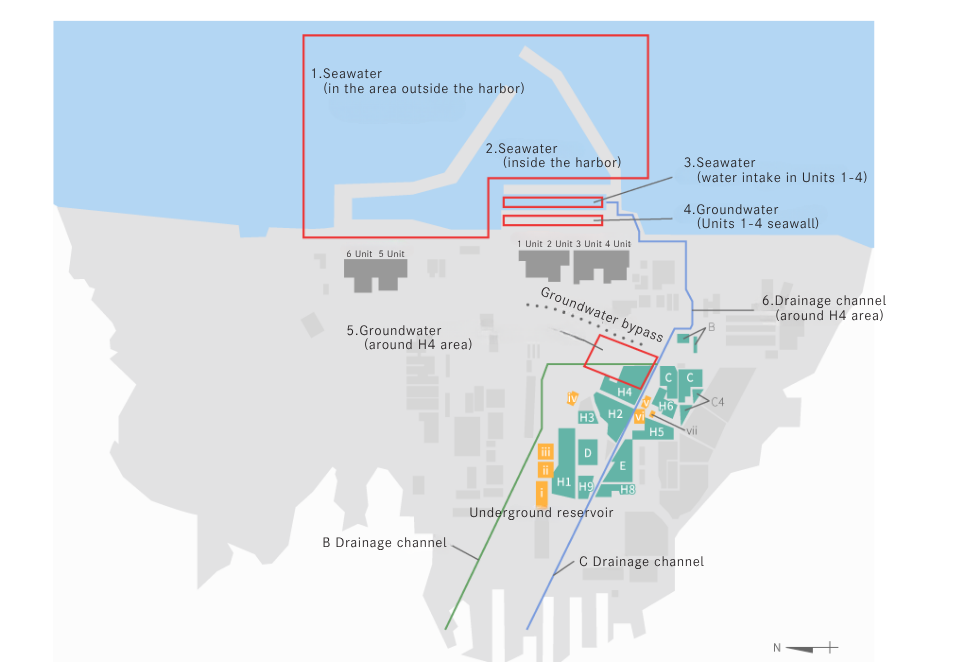
Source: TEPCO HD
Significant changes to analytical operations due to the introduction of LIMS
Impact in numbers: 800,000 sheets of paper per year eliminated
The introduction of SEIKO EG&G‘s LIMS has significantly changed chemical analysis operations at the Fukushima Daiichi Nuclear Power Plant. One of these changes is the decreased risk of human error due to changes in data entry methods. Before LIMS’s introduction, because the process involved transcription between check sheets or manual input into computers, there was a risk of input or transcription errors regarding analysis conditions (such as sample date and time and amount of sample used for analysis) and analysis results. However, with the introduction of LIMS, the risk of human error has been reduced through features that allow real-time double-checking of input data, the elimination of transcription tasks through centralized management of analysis conditions, and the elimination of manual input tasks through the automatic acquisition of analysis results.
The second change is the streamlining of analysis work by reducing manual data entry and checking tasks. Prior to implementation, there were approximately 1.5 million manual entry tasks undertaken annually, such as entering and checking analysis conditions and results at each step of the analysis process. However, the introduction of LIMS has reduced this work by approximately 80%. As a result, the time required for processing one day‘s worth of analysis data (approximately 80 samples) was reduced from approximately 57 (people/hours) to approximately 19 (people/hours).
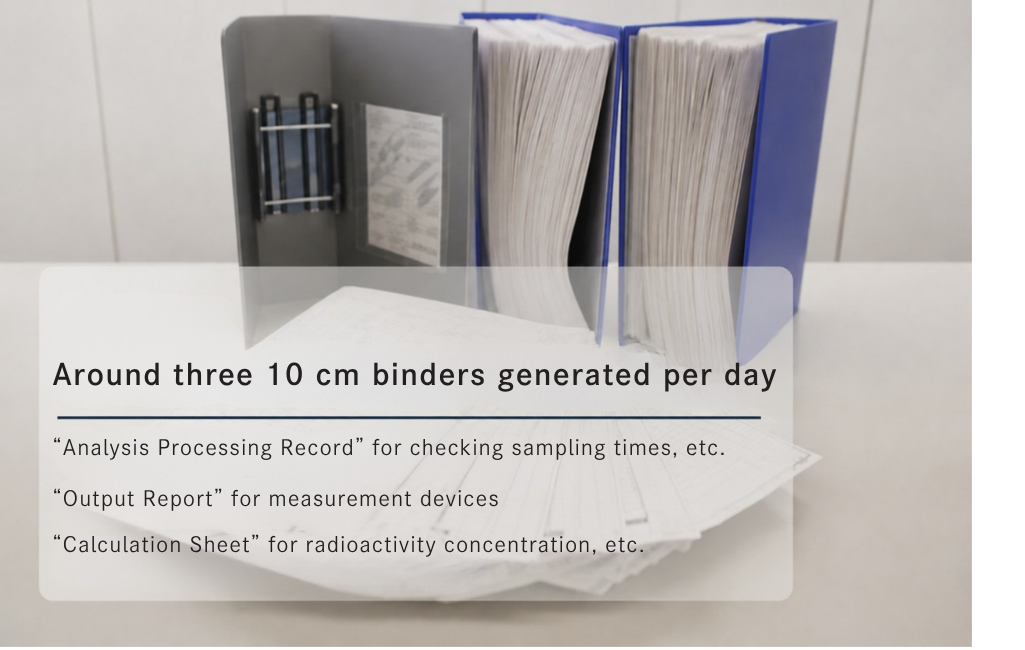
The third change is the reduction in paper associated with the discontinuation of check sheets. Before the introduction of LIMS, approximately 800,000 check sheets were used annually, the equivalent of three 10 cm-thick binders per day. The introduction of LIMS has enabled the automatic import of analysis result reports and a reduction in checking work, which has led to the elimination of check sheets and the realization of a paperless environment.
Qualitative Changes: Standardization and Sophistication of Analysis Work
Before the implementation of LIMS, there were analysis tasks that only certain skilled experts could perform. Previously, analysis work was standardized by defining procedures, and analysts proceeded according to manuals; however, since the introduction of LIMS, analysis procedures are now displayed on smart glasses, creating an environment where anyone can perform analysis work of the same quality by following the displayed procedures.
“By streamlining analytical tasks, we have been able to allocate personnel to acquire technical capabilities and skills for more complex analyses. Additionally, we have benefited from operations no longer being dependent on specific individuals.” That is how the person in charge describes the magnitude of the change, which does not appear in the numbers.
A “Competency Management” function has also been added. When an analyst logs into the system, it is configured so that they can only access the tasks they are authorized to handle. This enables standardization of analytical work while ensuring that only analysts with the necessary skills are assigned to processes requiring expertise.
-1.png?width=1168&height=553&name=%E5%B9%B4%E9%96%938%E4%B8%87%E4%BB%B6%E3%81%AE%E5%8C%96%E5%AD%A6%E5%88%86%E6%9E%90%E3%82%92%E5%8A%87%E7%9A%84%E3%81%AB%E5%8A%B9%E7%8E%87%E5%8C%96%E3%81%97%E3%81%9F%E3%82%B7%E3%82%B9%E3%83%86%E3%83%A0%20(4)-1.png)
Source: TEPCO HD
Background of System Development and Smart Glasses Integration
4 Years of Trial-and-Error Development
The catalyst for development was a request from TEPCO HD: “Commercially available LIMS do not fit the practical needs of the chemical analysis industry, so we would like you to build one for us.”
SEIKO EG&G has a long-standing business relationship with TEPCO HD through various radioactivity analysis instruments, and so there was a certain degree of prior understanding of the actual analytical work at the Fukushima Daiichi Nuclear Power Station. Furthermore, there was a track record of delivering SEIKO EG&G’s own Ge (germanium) semiconductor detectors and developing custom software for them. A Ge semiconductor detector is a device used to detect gamma rays and X-rays.
First, an “evaluation system” was trial-introduced, and this proceeded with improvements based on feedback from the field. It took 3-4 years from development to the start of operation, but thanks to SEIKO EG&G‘s deep understanding of radiation analysis operations, a system capable of ensuring analysis quality was developed.
“To build a system capable of ensuring analysis quality, it is vital to understand the business and the industry. Since we have been working with TEPCO HD for many years, I believe the fact that they didn‘t need to teach us everything from scratch is what led to this request,” is the analysis of the person in charge.
Modification of smart glasses specialized for decommissioning sites
One of the requests from TEPCO HD was for hands-free operation. There are many items, such as glassware and reagents used for analytical pretreatment, that require delicate handling with both hands. That is why smart glasses have been adopted.
However, at that time, there were no products with voice input functionality and operability that were suitable for business operations. Therefore, SEIKO EG&G added proprietary modifications to commercially available smart glasses, incorporated a microphone, speaker, and camera (video transmission function), and finished it as a dedicated terminal capable of handling input of pre-processing information, execution of measurement analysis, and confirmation of analysis results (checking trend graphs) via voice input.
Additionally, because the analysis work would be interrupted if the smart glasses fell off during operation, they were designed in a shape that allows the main smart glasses unit to be secured to a helmet-type frame. A mechanism is also incorporated to flip up the lens (display) when the smart glasses are not in use, depending on the progress of the work.
Regarding the on-site situation, the person in charge says the following: “At the Fukushima Daiichi Nuclear Power Station, chemical analysis work is performed while wearing multiple layers of gloves, which made it difficult to operate a mouse or keyboard. There was a need for hands-free voice input capabilities, including those aspects.”
.png?width=994&height=653&name=%E5%B9%B4%E9%96%938%E4%B8%87%E4%BB%B6%E3%81%AE%E5%8C%96%E5%AD%A6%E5%88%86%E6%9E%90%E3%82%92%E5%8A%87%E7%9A%84%E3%81%AB%E5%8A%B9%E7%8E%87%E5%8C%96%E3%81%97%E3%81%9F%E3%82%B7%E3%82%B9%E3%83%86%E3%83%A0%20(6).png)
Features to ensure work efficiency and accuracy
Hands-free operation using smart glasses
The analyst scans the sample‘s QR code while wearing smart glasses, and then inputs information such as the collection date and time with their voice (speech). Work procedures are displayed on the smart glasses, and work proceeds according to those instructions. Once the work according to the instructions is complete, confirmation is provided via voice, and the user moves on to the next analysis task. Once the measurements are complete, in addition to the current measurement results, a trend graph of past analysis values for that sample is displayed on the smart glasses. This function is also useful for determining the presence or absence of abnormal values.
Real-time checks and other manufacturers’ equipment including centralized management
What makes SEIKO EG&G‘s LIMS significantly different from other systems is the mechanism that “allows errors to be caught along the way.” At the same time as an on-site analyst inputs the sample collection date and time with their voice, an office manager checks the camera footage, and, after manually entering the collection date and time, etc. into the system, the program confirms that the data input with voice by the analyst matches the data manually input by the manager. Thanks to this real-time double-checking function, if a discrepancy occurs, it is identified on the spot.
Regarding this design philosophy, the development manager explains it as follows: “Two people must input the data, and checks are performed systematically. I believe that AI or anything else can make mistakes, so this system is designed to minimize the risk of error as much as possible by incorporating human checks where necessary.”
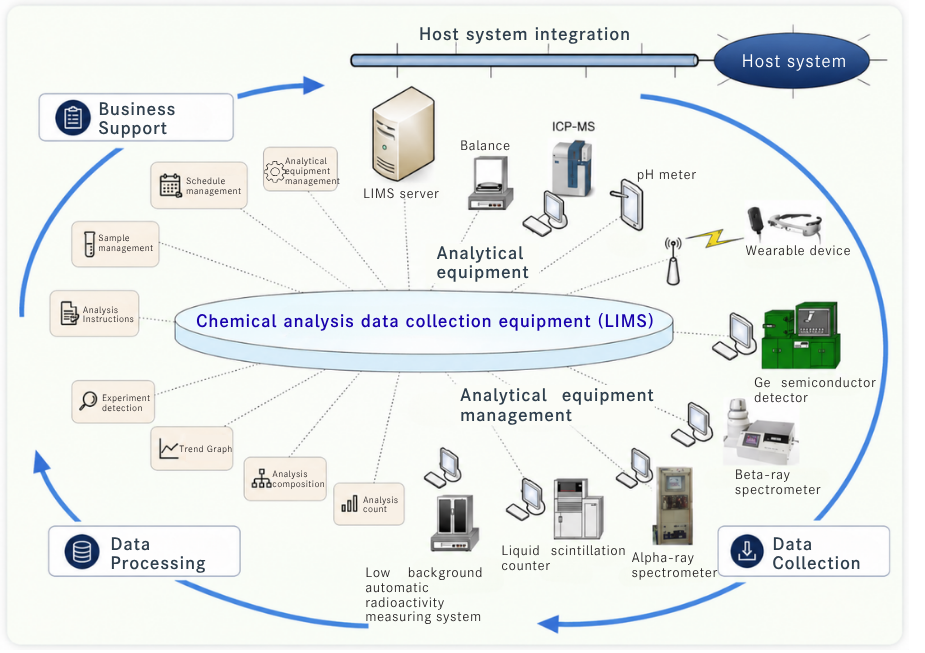
SEIKO EG&G‘s LIMS automatically acquires analysis results from measurement equipment. It is possible to automatically acquire and centrally manage data not only from SEIKO EG&G measurement equipment but also from equipment made by other manufacturers. It is also integrated with TEPCO HD‘s core system, so the entire data flow, from receiving analysis instructions to the automatic transmission of analysis results, is completed within the LIMS. The final approved data will be published on the TEPCO HD website.
.png?width=1159&height=550&name=%E5%B9%B4%E9%96%938%E4%B8%87%E4%BB%B6%E3%81%AE%E5%8C%96%E5%AD%A6%E5%88%86%E6%9E%90%E3%82%92%E5%8A%87%E7%9A%84%E3%81%AB%E5%8A%B9%E7%8E%87%E5%8C%96%E3%81%97%E3%81%9F%E3%82%B7%E3%82%B9%E3%83%86%E3%83%A0%20(5).png)
Source: TEPCO HD
LIMS specialized for nuclear power plants
Why a system specialized for the chemical analysis industry is necessary
The greatest feature of the LIMS developed by SEIKO EG&G is that, in addition to data management functions, it can also provide “operational support.”
At chemical analysis sites, pre-processing procedures and measurement conditions vary depending on sample characteristics and the types of radioactive material targeted. Because smart glasses provide instructions for these complex work procedures, it is possible to both mitigate human error and ensure reliability.
Commercially available LIMS do not support the unique workflows of the chemical analysis industry or integration with measurement equipment. SEIKO EG&G built a system that is easy to use in the field by combining their expertise in radiation measurement with their understanding of the actual work operations at TEPCO HD. The calibration deadlines for each analytical instrument can also be managed by the system.
The possibilities of technology assisting decommissioning processes, which is garnering global attention
The first prospect is further expansion into the chemical analysis industry. Radiopharmaceutical manufacturers can verify quality using Ge semiconductor detectors before shipment. SEIKO EG&G has already delivered measurement equipment, and there is potential for further expansion by combining this with the data management functions of LIMS.
Regarding expansion to other electric power companies, there is room for consideration of proposals with limited scope, such as systematizing only a portion of measurement operations. LIMS is designed based on the concept that it can be customized for each customer, enabling flexible support.
Chemical analysis work at the Fukushima Daiichi Nuclear Power Station is essential for advancing decommissioning work. SEIKO EG&G‘s LIMS supports the responsibility of checking radioactivity concentrations and water quality analysis values daily, and continuously disclosing this data to the public. SEIKO EG&G prides itself not only on equipment sales, but also on software development and support for broader operations.
Since the Great East Japan Earthquake, some people view nuclear power generation as dangerous. However, there is work being done here that allows people to contribute to society by being involved as engineers in the national project of decommissioning. The decommissioning of the Fukushima Daiichi Nuclear Power Station is a project that is attracting attention not only within Japan, but also from nuclear energy stakeholders all around the world.
Interview support
To those involved at Seiko E&G Co., Ltd.